55+ Community Myths Debunked: Family Visits, Age Rules, Inheritance & Resale in Greater Sacramento
A fact-based guide from Gary Lee and NorCal55Plus.com explaining what Northern
California 55+ communities are really like, and correcting several common misconceptions
about family visits, residency, home size and resale.
Last verified:
Share This Article
Pass this article along to a friend, family member, or neighbor planning their next chapter.
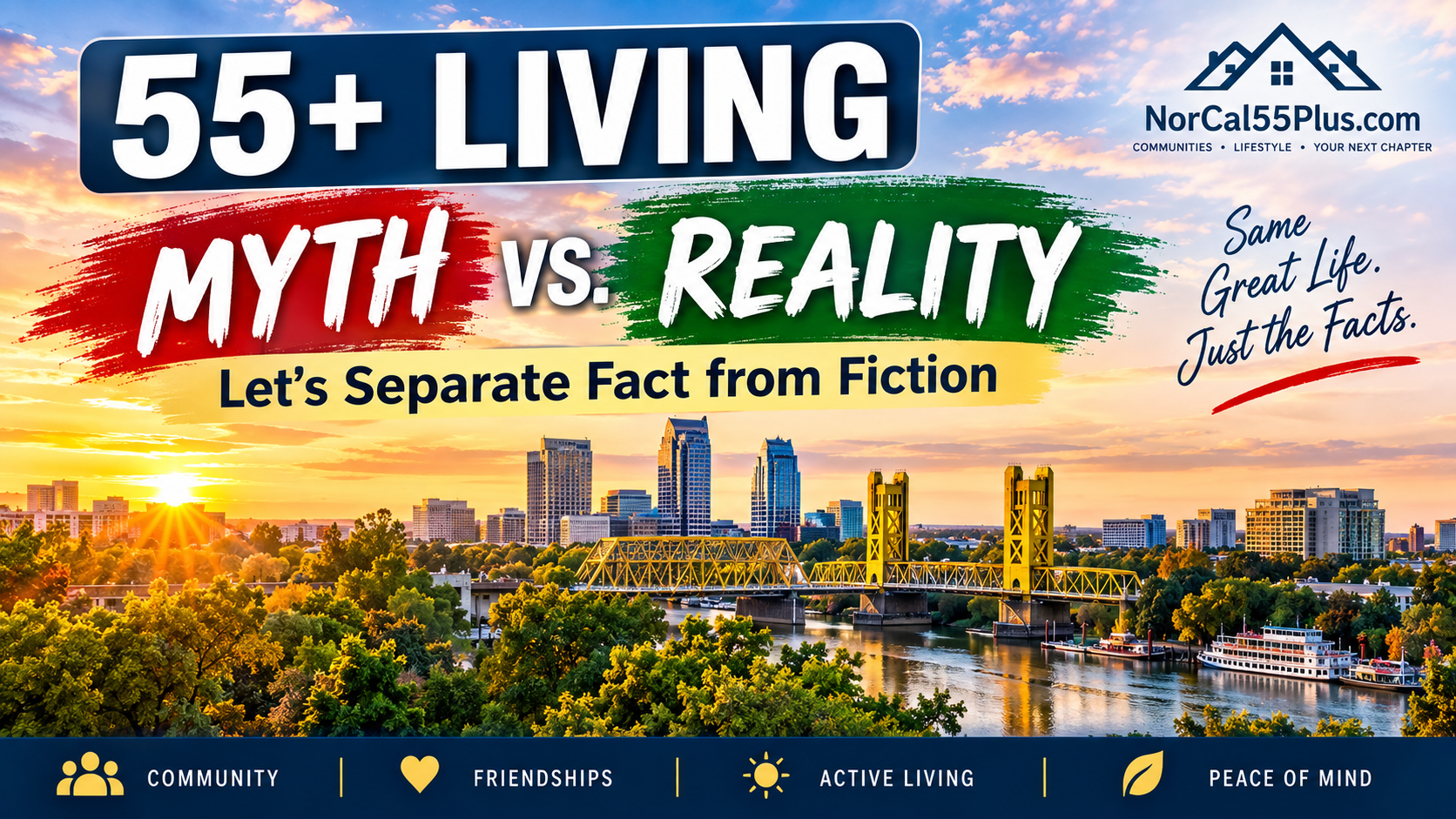
The video that pairs with this guide, "55+ Housing: Resort-Style Communities, Myths
Busted!," from Gary Lee and the official NorCal55Plus YouTube channel. This image is the
featured thumbnail of the post.
There are a lot of myths about 55 and older communities. Some people think your family
cannot visit. Others think everyone living there has to be 55. Some believe the homes are
small, the lifestyle is restrictive, or that moving into one means giving something up.
Recently, a well-known, experienced Sacramento-area realtor released a video about
retiring near Sacramento without living in a 55 and older community. She appears to be a
very good realtor, but several statements she made about 55 and older living simply were
not accurate. That raised an important question: if an experienced real estate
professional can misunderstand how these communities work, there is a good chance many
buyers and families misunderstand them too. That is exactly why this video, and this
article, were created.
Quick Answer:
Children and grandchildren can visit 55+ communities. Not every permanent resident
necessarily has to be 55 or older. A younger person may also inherit or own a home
even when community rules restrict who may permanently occupy it. Guest policies,
secondary-resident ages, amenity access and occupancy rules differ from one community
to another. NorCal55Plus.com tracks these differences across approximately 35
active-adult communities in Greater Sacramento and Northern California.
At a Glance: The Real Rules of 55+ Resort Communities
Can Grandchildren & Family Visit? Yes. Federal and HOA
regulations govern permanent residency, not normal family visits. Family members and
grandchildren of all ages can stay, celebrate holidays, and use community amenities.
How Long Can Guests Stay? Extended visits are permitted. Most
communities permit guest stays ranging from 30 to 90 consecutive days (or up to
several months per year), making summer vacations with grandchildren fully
compliant.
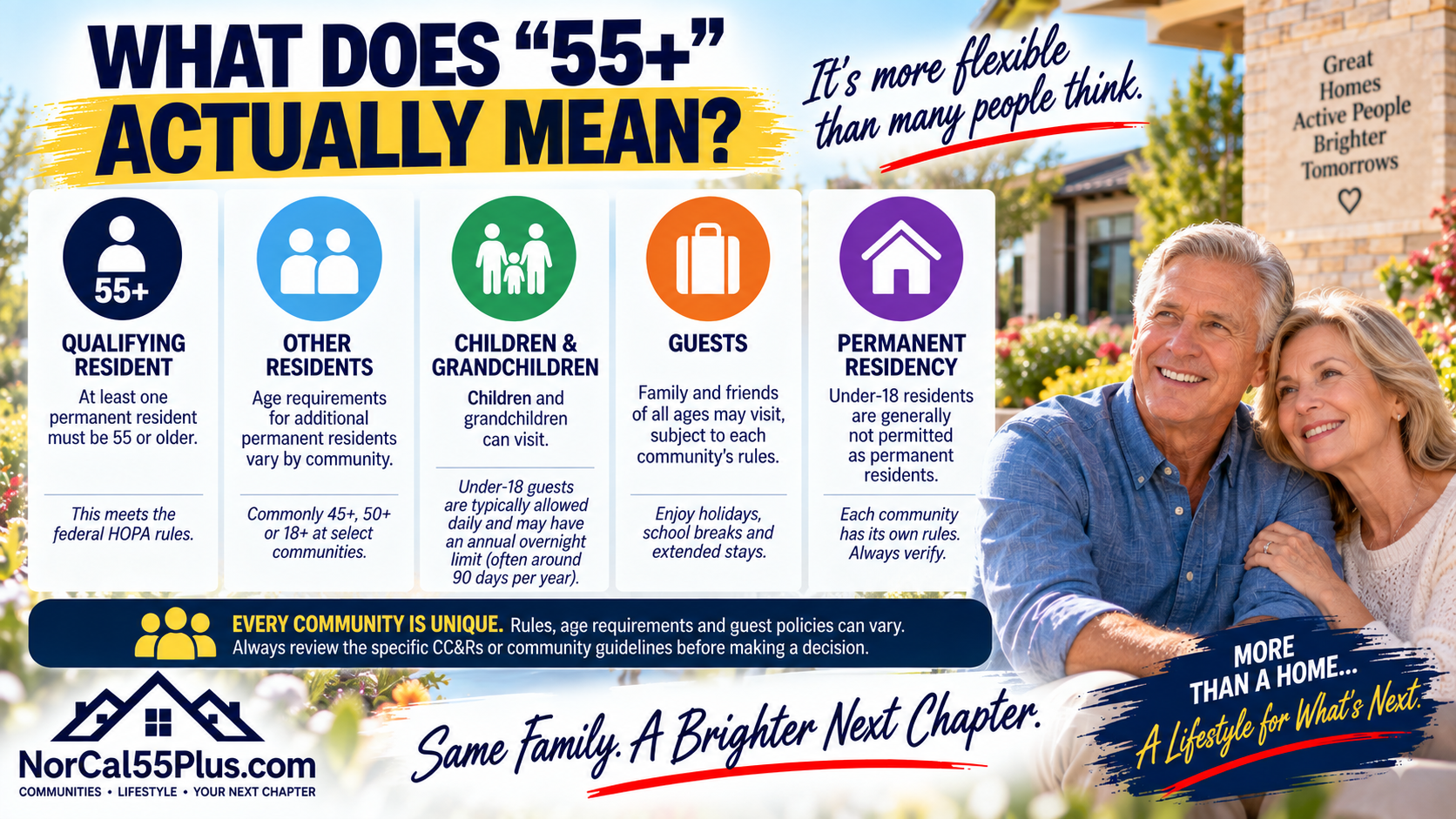
Does Everyone Living in the Home Have to Be 55+? No. Master-planned
55+ communities require one "qualifying resident" to meet the age minimum. Secondary
residents (spouses, partners, adult children, or caregivers) can often be 18, 45, or
50+, depending on the community's specific CC&Rs.
Can Heirs Under 55 Inherit the Property? Yes. Under California and
federal law, ownership and occupancy are distinct. An underage heir can inherit the
legal title and equity, but occupying the home full-time is subject to the
community's age-qualification bylaws.
Are 55+ Homes Small? No. Greater Sacramento 55+ homes range from
1,200 sq. ft. low-maintenance patio villas to over 3,000 sq. ft. semi-custom luxury
estates with detached guest casitas, three-car garages, and RV parking.
Why trust this guide?
Gary Lee has been a full-time California REALTOR® since 2004 and specializes in
Northern California 55+ communities. Through NorCal55Plus.com, Gary and Rutsell Lee
research communities firsthand through community visits, builder meetings, home
tours, resident conversations, governing-document review and local market analysis.
Meet your specialists
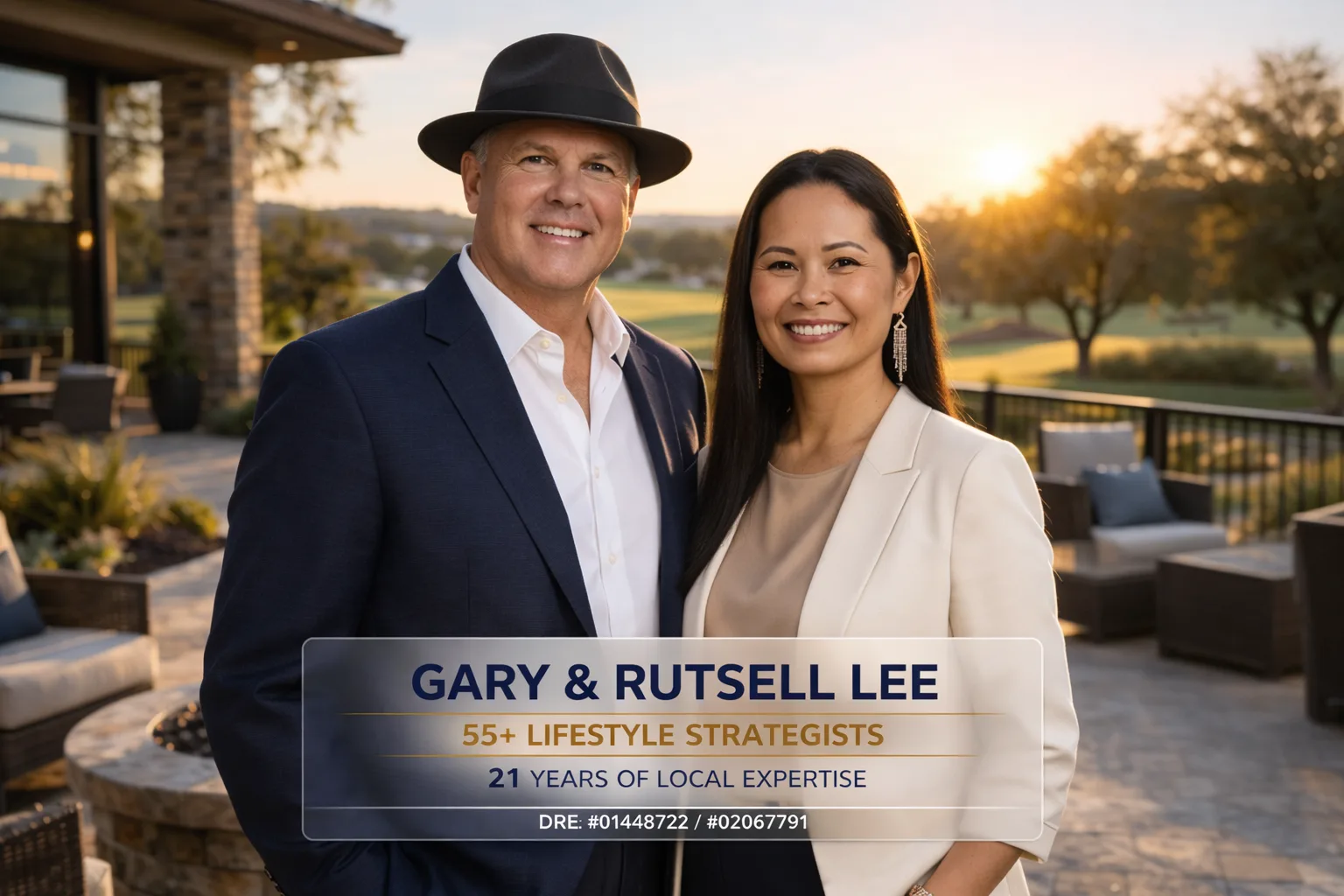
Meet Gary & Rutsell, your Northern California 55+ REALTORS
Gary Lee has been a full-time California REALTOR® since 2004.
Rutsell Lee is also a
California REALTOR® and co-founder of The Gary Lee Team. Together they research Northern
California 55+ communities, tour homes and amenities, and help buyers and sellers compare
their options throughout Greater Sacramento and Northern California.
The Gary Lee Team · eXp Realty of Northern California, Inc.
Gary separates the myths from the reality myth by myth, responding to the September 2026
Sacramento-area realtor video respectfully and factually. You can also
watch it directly on YouTube
.
Watch more unfiltered clubhouse and street-level tours in our
Community Video Vault.
One of the statements in that September 2026 video was this: "Less flexibility for family
visits, an age restricted community, and fewer future buyers." There are actually several
different ideas packed into that one statement. Let's start with family visits first.
Myth 1: Your family cannot really visit
What does 55 and older actually mean? It does not automatically mean every person living
in every home must be 55 or older. Usually there is a qualifying resident who meets the
age requirement. Who else may permanently live in the home depends on the individual
community. Guest rules are different from residency rules.
The federal rules behind this come from the
Housing for Older Persons Act of 1995 (HOPA)
, which requires that at least 80% of occupied units in a qualified 55+ community have at
least one resident who is 55 or older. Our explainer on age requirements and the HOPA
rules walks through how that 80/20 rule works in practice.
Can your children and grandchildren visit you in a 55 and older community? Absolutely.
These communities are not designed to separate you from your family. Your kids can come
over. Your grandkids can visit. You can celebrate birthdays, holidays, family dinners,
and special occasions just like anybody else. What the community regulates is primarily
permanent residency, not normal family life.
And a family visit does not necessarily mean just Saturday afternoon. In many
communities, younger guests can stay for extended periods. That may mean several weeks,
summer vacation, or even a few months during the year depending on the specific guest
policy. So if your grandchildren are out of school for the summer, or your family flies
in from across the country and wants to stay for a month, that can often be completely
workable. You simply need to know the rules of that particular community.
There is also no underage police force driving around these neighborhoods. Nobody is
standing outside grandma's house with a stopwatch trying to decide whether the
grandchildren have been there for 90 days or 93 days. These are normal residential
communities. Age verification is primarily about permanent residency and maintaining the
community's age qualified status. It is not about keeping your family away.
Now, let's stop talking about rules for a moment and talk about real life. Grandma and
grandpa can have the grandchildren over and go play pickleball together. That is not some
unusual exception. In many communities, visiting family members can participate in
activities with the resident subject to the community's amenity rules. This is what
family visits can actually look like.
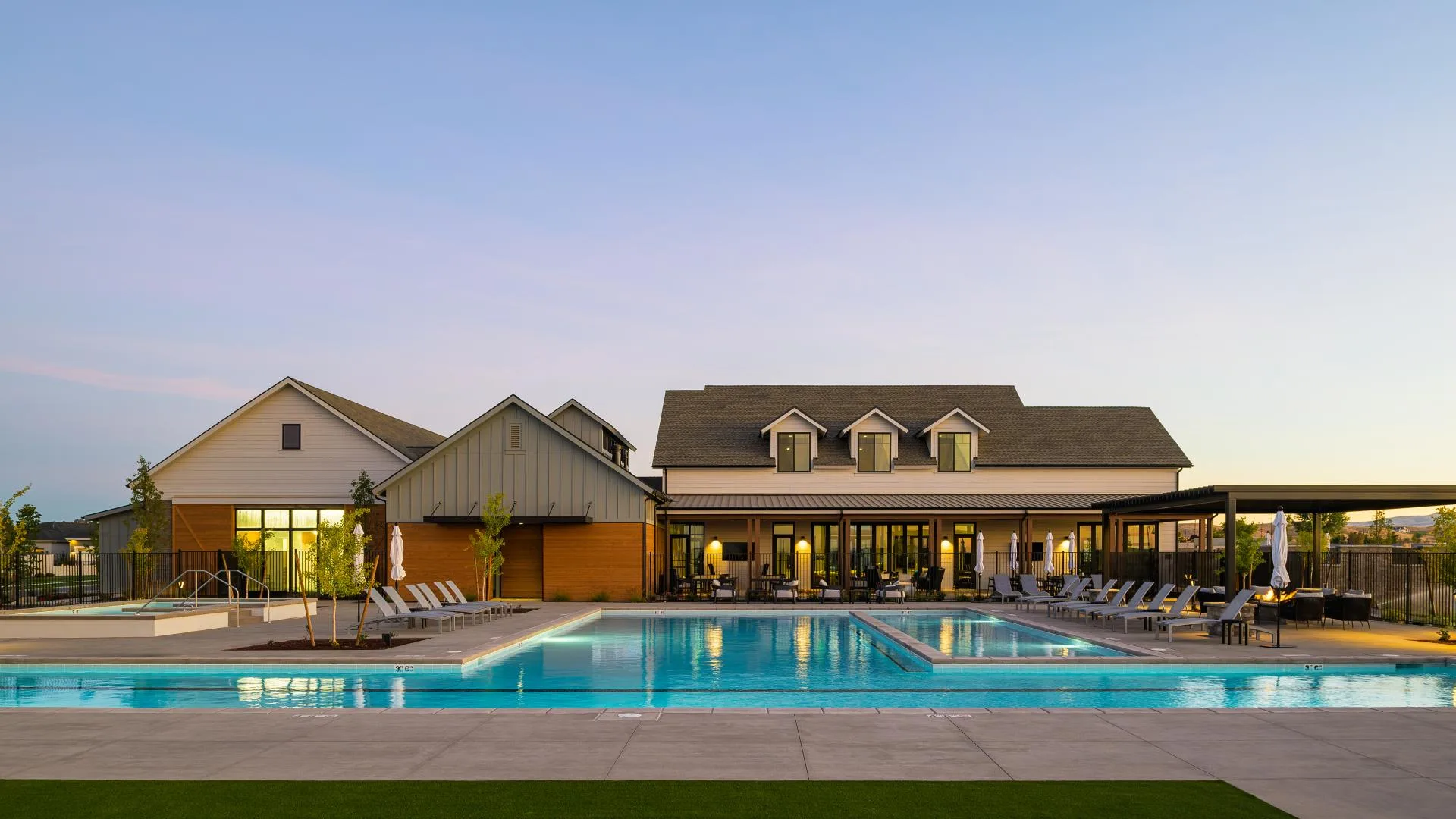
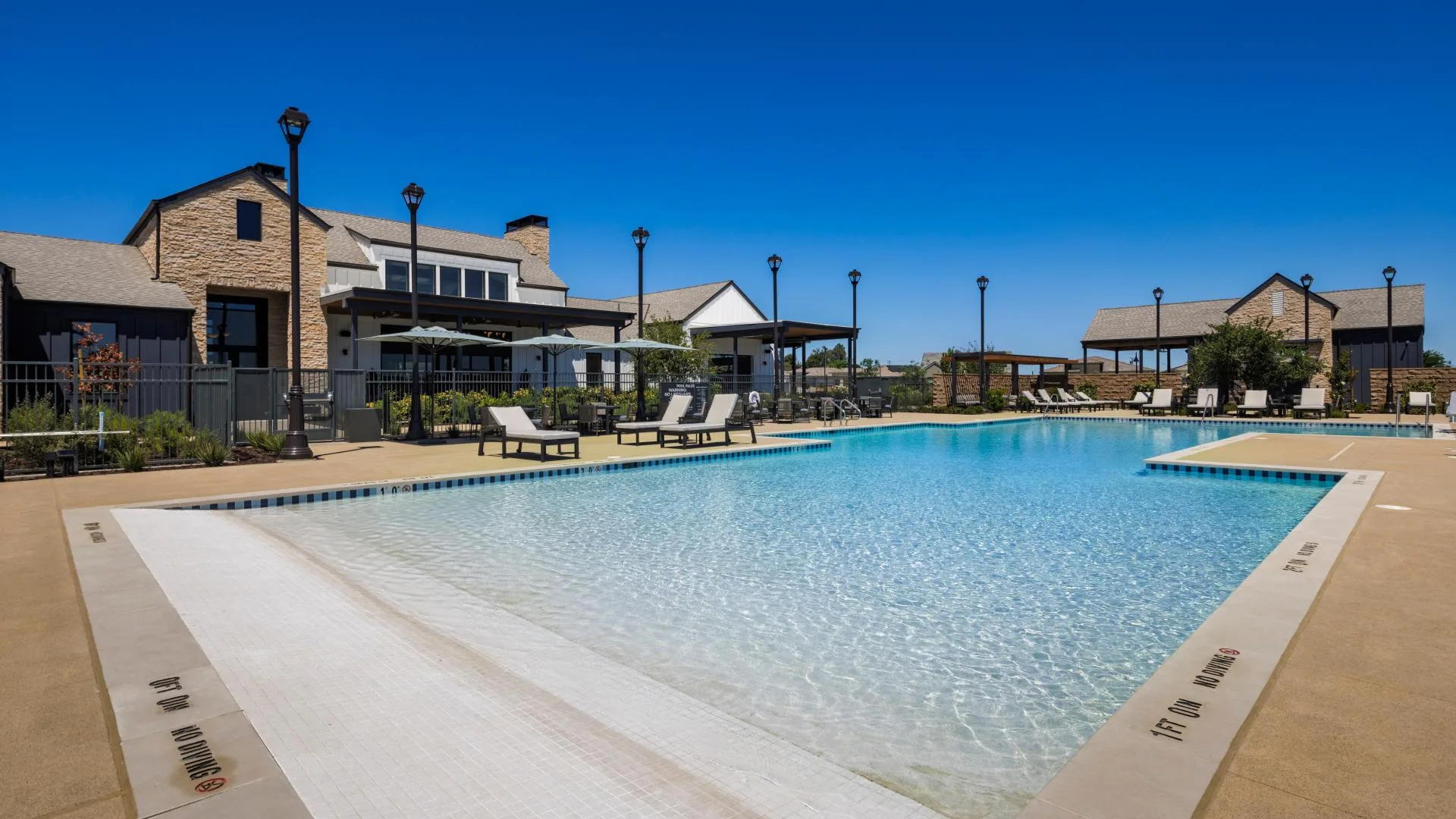
The same thing can happen at the swimming pool. Grandparents, their adult children, and
the grandchildren can spend the day together while other residents enjoy the pool around
them. These communities are not designed to make family disappear. They are designed to
create an active adult neighborhood while still allowing residents to enjoy the people
they love.
Sometimes the best part is something as simple as grandpa taking his grandson out on the
golf cart. Maybe they play a few holes together. Maybe they just ride around and talk.
That is the part people sometimes miss when they describe 55 and older living as
restrictive.
Myth 2: "Grandkids can visit, move in, or inherit the place someday"
Another statement in the video said, "Grandkids can visit, move in, or inherit the place
someday since there's no age restrictions stopping them." Those are actually three
completely different subjects: visiting, permanently living in the home, and owning or
inheriting the property. They should not be treated as though they are the same thing.
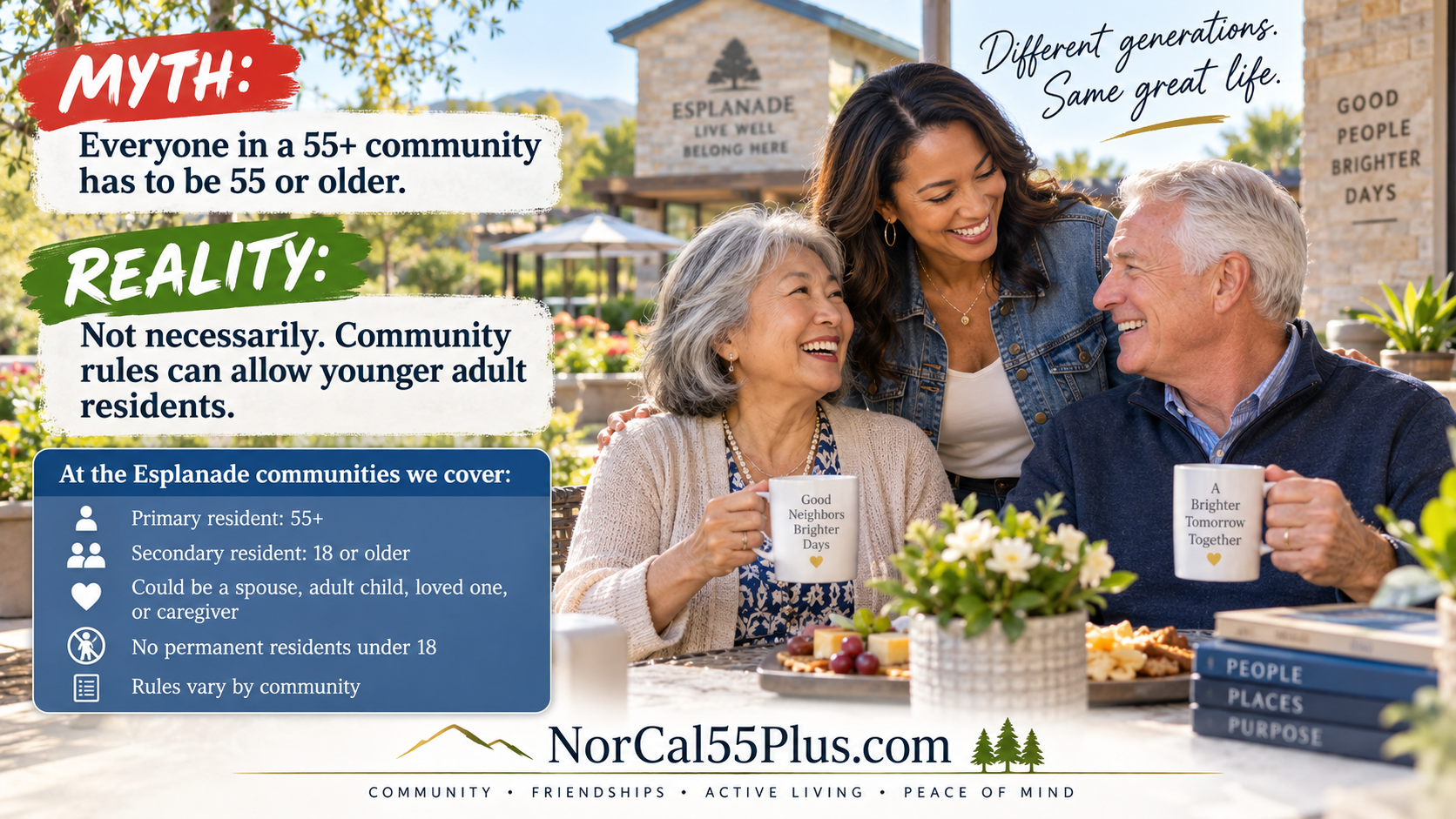
Here is a perfect example. At both
Esplanade communities that we cover
, the qualifying resident must meet the 55 and older requirement. But a secondary
permanent resident may be 18 or older. That could be a spouse, an adult son or daughter,
another loved one, a companion, or even a caregiver. So a 60-year-old resident could
potentially live with a 30-year-old adult child. That is very different from saying
everyone in the household has to be 55.
Source: current Esplanade community residency information; last verified September 2026.
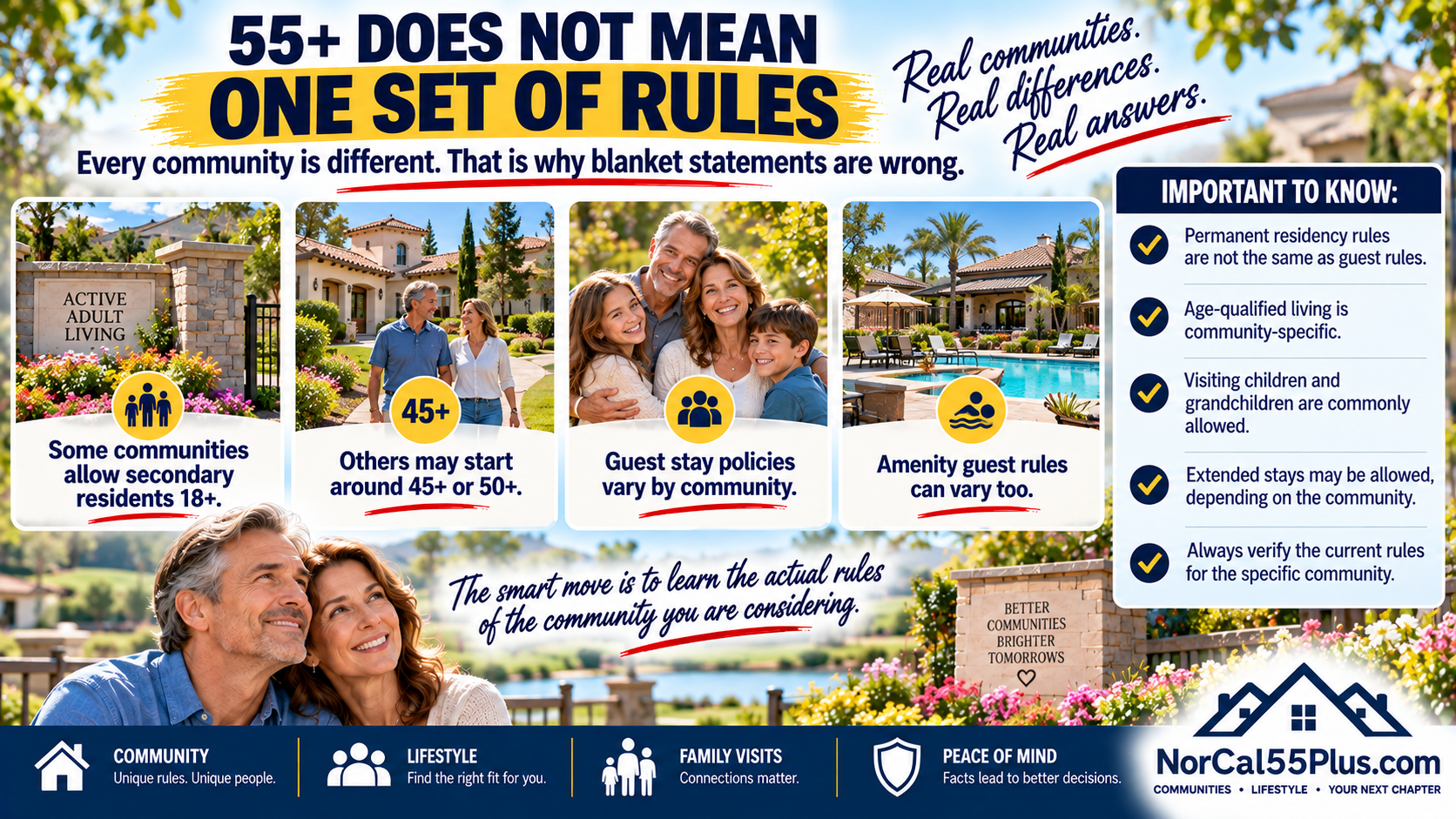
This is why blanket statements about 55 and older communities are dangerous. One
community may allow a secondary resident beginning at 18. Another may use 45. Another may
use 50. Guest policies can be different. Amenity rules can be different. Permanent
residency rules can be different. There is no single rule book that applies to every 55
and older community. You have to know the actual community.
Now, let's go back to inheritance. A younger child or grandchild may potentially inherit
or own a home in a 55 and older community. Ownership and occupancy are two different
things. Whether that younger owner can personally live in the property depends on the
occupancy rules of that specific community. So saying that grandchildren can inherit a
home only in an unrestricted neighborhood creates the wrong impression.
Myth 3: The lifestyle is restrictive
The video also said, "The trade-off nobody mentions is what you give up to get that."
But that assumes the age-qualified environment is something residents reluctantly
tolerate. For many people, it is the exact opposite. Living around people at a similar
stage of life is one of the reasons they chose the community in the first place.
When people buy in many of these communities, they are not simply buying a house. They
are buying a lifestyle. They are buying access to clubhouses, fitness facilities, social
events, walking groups, pickleball, swimming, arts and crafts, clubs, classes, and
sometimes golf or community dining. They are also buying the opportunity to meet people
who actually have time to enjoy those things with them.
This is not what most people picture when they hear the words retirement home. These are
active adult communities. There may be multiple activities happening every single day.
Fitness in the morning, pickleball later, lunch with friends, a club meeting in the
afternoon, music, entertainment, cards, crafts, swimming, golf, or a community event in
the evening. You can be as busy as you want to be.
These communities are sometimes described as feeling like a fountain of youth. Not
because moving there magically changes your age: it changes your opportunities. You can
spend the entire day sitting in a recliner if that is what you want. Or you can walk
outside and have people to see, places to go, activities to join, and reasons to keep
moving. That difference can be enormous.
Then there are the friendships. You start recognizing people at the clubhouse. Someone
becomes your walking partner. Someone else becomes your pickleball partner. Maybe another
couple becomes the people you meet for dinner every Friday night. These relationships are
one of the reasons many residents consider these communities their forever home. They are
not just connected to the house. They become connected to the people.
The activities also give you choices. You might walk the trails in the morning, take a
fitness class, play pickleball, work on a hobby, join a club, play golf, attend an event,
or simply sit outside with friends. The point is not that you have to do everything. The
point is that you have choices every day.
Myth 4: The homes are small
There is another major advantage that people often overlook. Many 55 and older homes are
designed around aging in place. Most of the homes we see are single-story. You will often
find wider hallways, wider doorways, open floor plans, easier access showers, and lower
maintenance designs. In many newer communities, even the amenities are being designed
with easier access in mind. The idea is simple: build a home that works well for you
today and can continue working well for you years from now.
And moving into a 55 and older community does not automatically mean moving into a tiny
house. The homes we see can range from around 1,200 square feet to approximately 3,000
square feet. There are modern kitchens, large great rooms, beautiful outdoor living
areas, guest suites, and in some communities casitas or additional family space. You may
be simplifying certain parts of your life. That does not mean you are settling for less.
For many people, this is not downsizing. It is right-sizing.
Myth 5: Fewer future buyers
Another statement from the original video was simply "fewer future buyers." At first,
that may sound logical. An age-qualified community does have a more specific buyer and
occupancy pool, but that is only half of the story. Many buyers actively search for these
communities by name. They are not simply looking for any house in the area. They may
specifically want the clubhouse, the golf, the fitness center, the single-story homes,
the social calendar, the neighbors, the lifestyle. In the communities followed by
NorCal55Plus.com, buyers often search for these communities by name, drawn by the
lifestyle and amenities, which creates targeted buyer demand. That is not a claim that
every 55+ home outperforms the market or holds its value better than other homes; values
always depend on the specific property, the market, and the community.
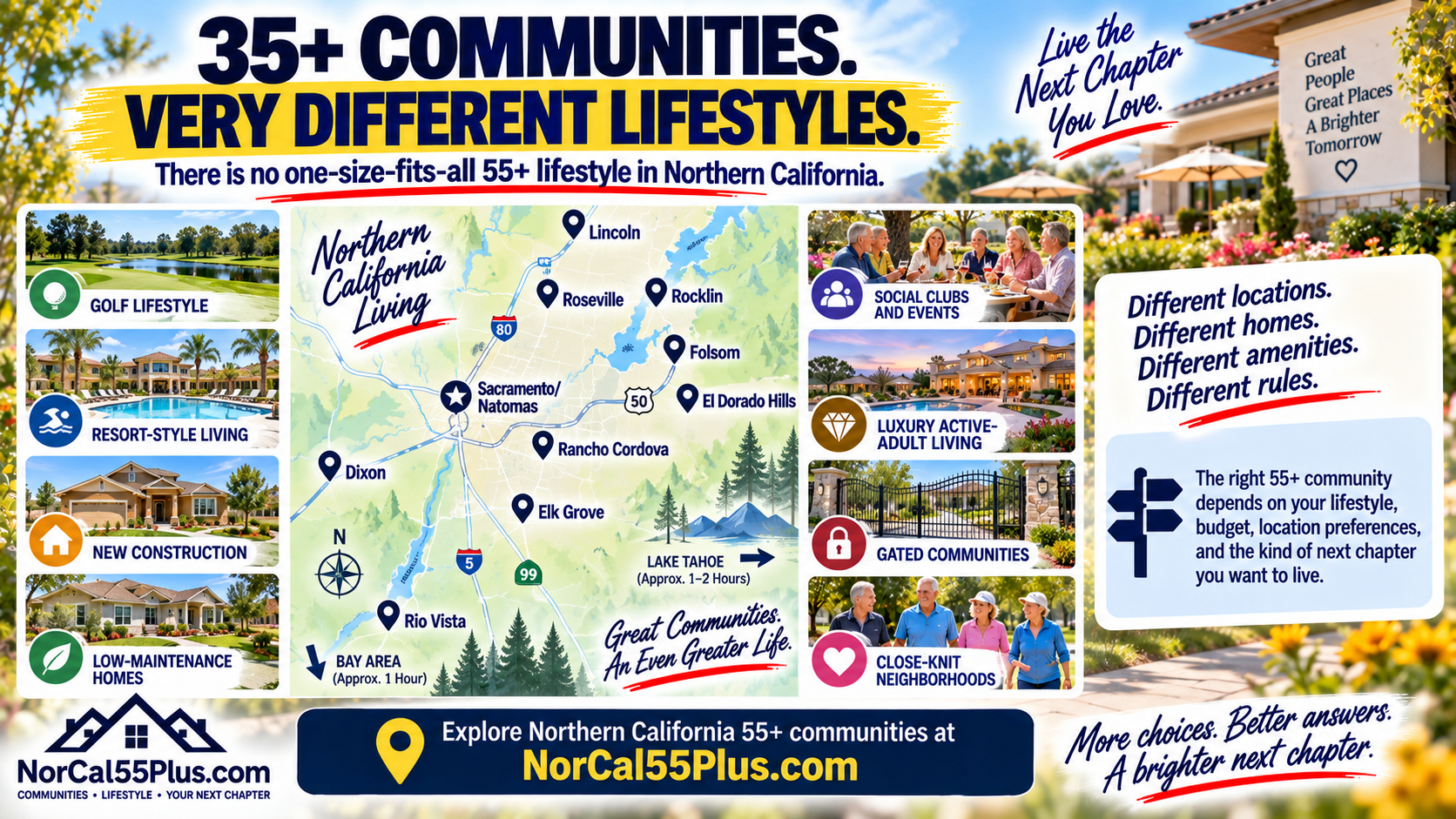
Why NorCal55Plus.com Tracks About 35 Northern California 55+ Communities
NorCal55Plus.com is a Northern California 55+ community research and real-estate
resource focused on helping buyers compare the rules, housing, amenities, costs and
lifestyles of approximately 35 active-adult communities across Greater Sacramento and
Northern California.
This is exactly why NorCal55Plus.com currently showcases approximately 35 active adult
communities throughout Northern California. There are more than that. We simply do not
feature every community.
NorCal55Plus coverage includes communities in and around Roseville, Lincoln, Rocklin,
Folsom, El Dorado Hills, Rancho Cordova, Elk Grove, Sacramento, Dixon, Rio Vista and
other Northern California markets.
Some are golf communities, like the ones we profile in our
Sun City Lincoln Hills
and
Sun City Roseville
guides. Some feel like resorts, whether the
Esplanade
communities with their Lodge-style amenities or the resort, community, and retreat trio
in our
Elk Grove guide
. Some are gated. Some are luxury communities. Some are new construction, like
Del Webb at River Islands
. Others are established neighborhoods with mature landscaping and resale homes, the
pattern buyers see across the Sun Cities and in communities like
Regency at Folsom Ranch
. There is no single 55 and older lifestyle.
10 Questions to Ask Before Buying in a 55+ Community
Before buying in any 55 and older community, ask the right questions. Here is the exact
list from Gary's video.
Who has to be 55?
How old can a secondary resident be?
What are the rules for children and grandchildren?
How long can younger guests stay?
Can guests use the amenities?
Are caregivers permitted?
What does the HOA cover?
Are there separate golf or club expenses?
What happens if your children inherit the property someday?
The right question is not, "What are the rules in a 55 and older community?" The right
question is,
"What are the rules in this community?"
Regional Communities Comparison
Buyers comparing 55+ communities across Placer, El Dorado, Sacramento and Solano
counties usually start with the age rules and the amenities. The table below compares
seven communities the site follows, based on current community information last verified
September 2026.
Guard-gated enclaves, luxury clubhouse, tennis, dog park
Del Webb at Rancho Cordova
Rancho Cordova (Sacramento)
55+ primary resident
Specific community guidelines apply
Modern clubhouse, indoor/outdoor pools, pickleball courts
Trilogy at Rio Vista
Rio Vista (Solano County)
55+ primary resident
Specific community guidelines apply
Ted Robinson golf course, waterfront proximity, health club
Always verify the current community documents, rules, and disclosures because
requirements vary and change.
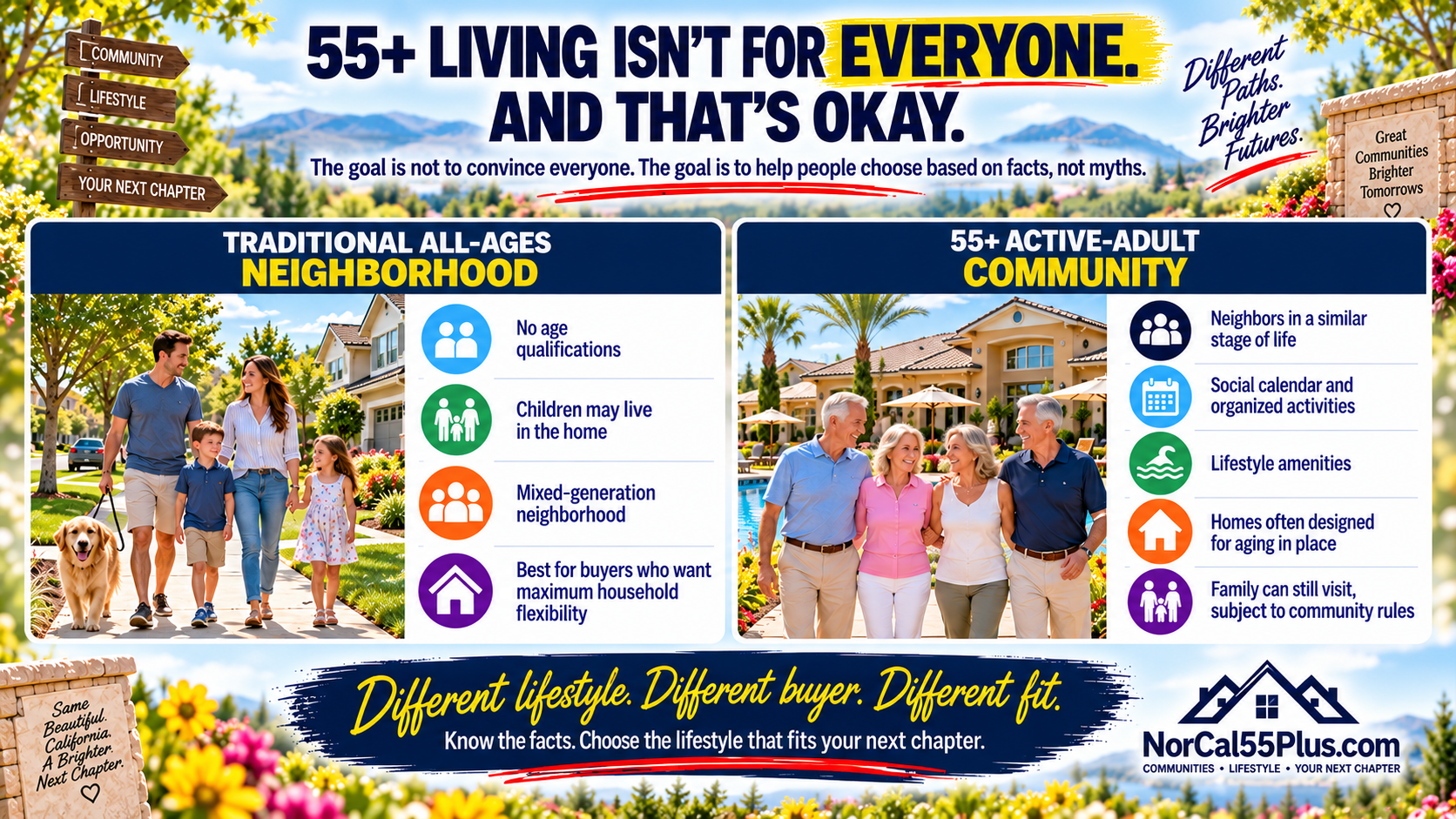
An honest closing: 55+ living is not for everyone, and that is okay
55 and older living is not right for everybody and that is completely okay. Some people
want a traditional neighborhood where children can permanently live in the household and
there are no age qualifications. Other people specifically want an active adult community
surrounded primarily by people at a similar stage of life. Neither choice is
automatically better. The right choice is the one that fits your life. Our goal is not to
convince everyone to live in a 55 and older community. Our goal is to make sure you do
not reject one because of information that simply is not true.
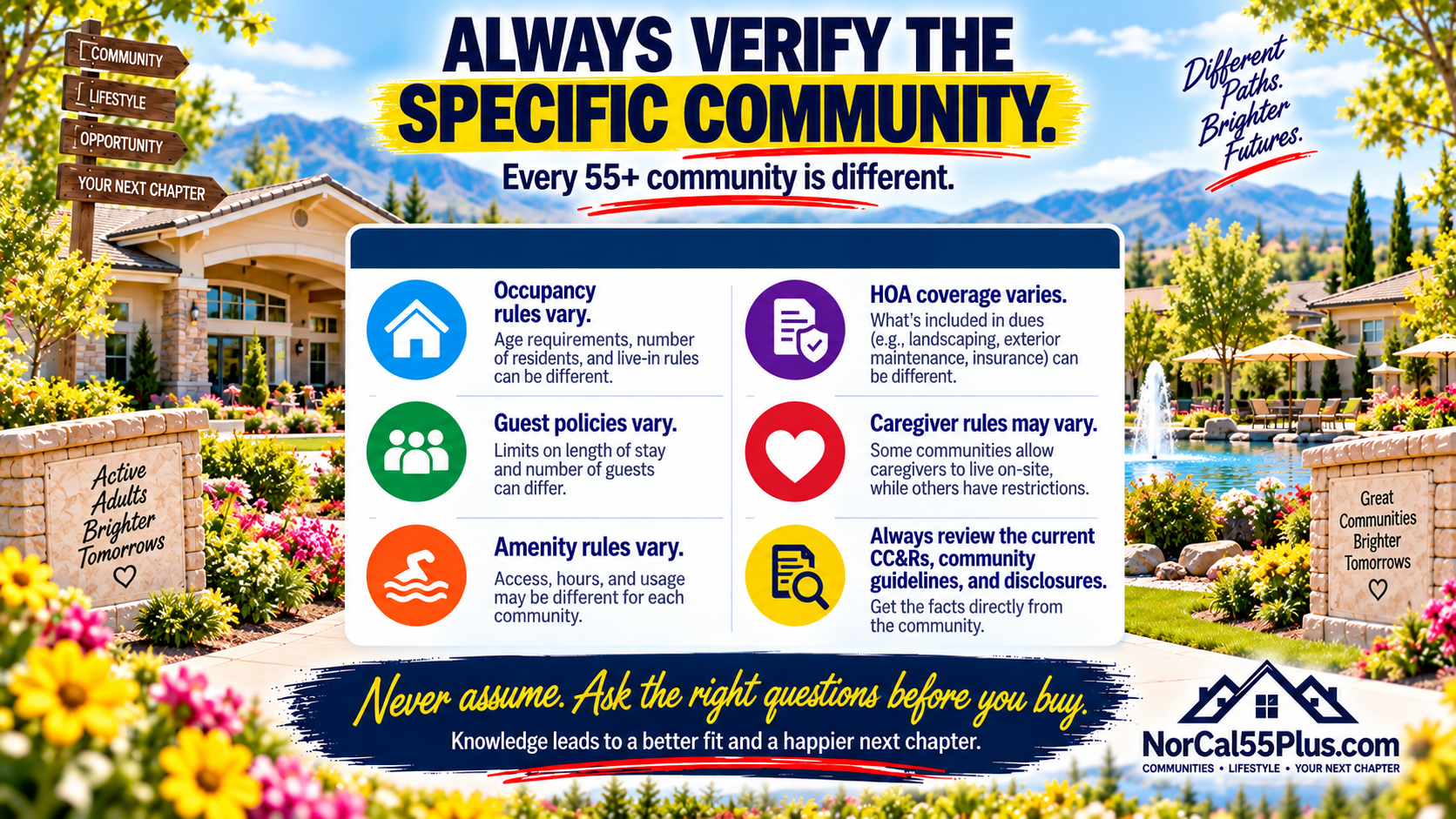
One final rule is extremely important: always verify the specific community. Occupancy
rules can vary. Guest policies can vary. Amenity access can vary. Caregiver provisions
can vary. What the HOA covers can vary. Always review the current community documents,
rules, and disclosures before making a decision. Never assume. Get the facts. For the
full buying path, our Buyer Information page on the main NorCal55Plus.com site gathers the current guides.
"55 and older living does not mean less family. Your children still come. Your
grandchildren still come. The holidays still happen. The summer visits still happen. The
dinners, birthdays, swimming, pickleball, golf, and memories still happen. The difference
is that when everybody goes home, you still get to live in the community and lifestyle
you deliberately chose. That is what 55 and older living is really about."
Why Work With Gary Lee for Northern California 55+ Real Estate?
Whether you are buying or selling in a 55 and older community, having the right realtor
can make a tremendous difference. You want someone who understands the communities, the
floor plans, the HOA, the amenities, the occupancy rules, the new construction, the
resale market, and most importantly, the lifestyle. A home can look perfect online. The
real question is whether the community fits the way you want to live.
Many real estate agents know how to sell a house. Far fewer truly understand the
differences between active adult communities, their residency rules, guest policies,
amenities, home designs, and the lifestyle that comes with each one.
Compare communities and explore lifestyles on
NorCal55Plus.com
. The Gary Lee Team operates under eXp Realty of Northern California, Inc.
If you found the video helpful, please like, share, and subscribe to the
NorCal55Plus YouTube channel
so you can keep up with more videos about 55 and older communities, real estate, and the
lifestyle choices that matter most.
Frequently asked questions about 55+ communities
The answers below come directly from Gary's video transcript, so the question you have is
the question he answers, in his own words.
Can my children and grandchildren visit me in a 55+ community?
Absolutely. These communities are not designed to separate you from your family. Your kids can come over and your grandkids can visit. You can celebrate birthdays, holidays, family dinners, and special occasions just like anybody else. What the community regulates is primarily permanent residency, not normal family life. In many communities, younger guests can stay for extended periods, which may mean several weeks, summer vacation, or even a few months during the year, depending on the specific guest policy.
Does everyone living in a 55+ community have to be 55 or older?
Not automatically. 55 and older does not mean every person living in every home must be 55 or older. Usually there is a qualifying resident who meets the age requirement, and who else may permanently live in the home depends on the individual community. Age verification is primarily about permanent residency and maintaining the community's age qualified status, not about keeping your family away. There is also no underage police force driving around these neighborhoods; nobody is standing outside grandma's house with a stopwatch trying to decide whether the grandchildren have been there for 90 days or 93 days. These are normal residential communities.
How old can a secondary permanent resident be?
It depends on the community, which is exactly why blanket statements are dangerous. At both Esplanade communities that we cover, the qualifying resident must meet the 55 and older requirement, but a secondary permanent resident may be 18 or older. That could be a spouse, an adult son or daughter, another loved one, a companion, or even a caregiver. One community may allow a secondary resident beginning at 18. Another may use 45. Another may use 50. There is no single rule book that applies to every 55 and older community.
Can grandchildren inherit or own a home in a 55+ community?
A younger child or grandchild may potentially inherit or own a home in a 55 and older community. Ownership and occupancy are two different things. Whether that younger owner can personally live in the property depends on the occupancy rules of that specific community. Saying that grandchildren can inherit a home only in an unrestricted neighborhood creates the wrong impression.
Are 55+ community homes small, and can they support aging in place?
Moving into a 55 and older community does not automatically mean moving into a tiny house. The homes we see can range from around 1,200 square feet to approximately 3,000 square feet. Most of the homes we see are single-story, with wider hallways, wider doorways, open floor plans, easier access showers, and lower maintenance designs. In many newer communities, even the amenities are being designed with easier access in mind. There are modern kitchens, large great rooms, beautiful outdoor living areas, guest suites, and in some communities casitas or additional family space. For many people, this is not downsizing. It is right-sizing.
Is the 55+ lifestyle restrictive?
No. These are active adult communities. There may be multiple activities happening every single day: fitness in the morning, pickleball later, lunch with friends, a club meeting in the afternoon, music, entertainment, cards, crafts, swimming, golf, or a community event in the evening. You can be as busy as you want to be, or spend the entire day in a recliner if that is what you want. When people buy in many of these communities, they are not simply buying a house. They are buying access to clubhouses, fitness facilities, social events, walking groups, pickleball, swimming, arts and crafts, clubs, classes, and sometimes golf or community dining, plus the opportunity to meet people who actually have time to enjoy those things with them.
Will I have fewer future buyers when I sell?
An age-qualified community does have a more specific buyer and occupancy pool, but that is only half of the story. Many buyers actively search for these communities by name. They are not simply looking for any house in the area. They may specifically want the clubhouse, the golf, the fitness center, the single-story homes, the social calendar, the neighbors, and the lifestyle. In the communities followed by NorCal55Plus.com, many of the larger active adult communities continue to attract strong buyer interest because buyers know exactly what they are looking for.
DRE #01448722 · Brokered by eXp Realty of Northern California, Inc.
Gary Lee has been a full-time California REALTOR since 2004 and specializes in
Northern California 55+ communities, relocation, resale and new construction. He
personally researches the communities featured on NorCal55Plus through community
visits, builder meetings, home tours, resident conversations and local market
analysis. This article is adapted from his video transcript, September 2026. DRE
#01448722.
"Know the facts. Understand the lifestyle. Choose the community that fits the life
you want to live."
Sources and References
This article is based on the transcript of Gary Lee's debunk video, published on the
official NorCal55Plus YouTube channel in September 2026, and stays in his own words
throughout. The well-known, experienced Sacramento-area realtor video referenced here is
deliberately not named or linked: this article responds to the statements, never to the
person.
Esplanade community residency informationCurrent Esplanade community residency details behind the 18+ secondary-resident example; last verified September 2026.
Community rules change and each community sets its own. Occupancy rules, guest policies,
amenity access, caregiver provisions, and HOA coverage all vary, so always review the
current community documents, rules, and disclosures before making a decision. Gary Lee,
CA DRE #01448722 · Rutsell Fabillar Lee, CA DRE #02067791 · Brokered by eXp Realty of
Northern California, Inc. All information deemed reliable but not guaranteed. Equal
Housing Opportunity.
Share This Article
Pass this article along to a friend, family member, or neighbor planning their next chapter.