Buyer Education · RV, Boat & Parking Rules
Can I Park an RV or Boat in a 55+ Community?
A California-specific buyer's guide to resident-only RV parking zones, off-site storage, and the CC&R rules that decide where your recreational vehicles can live, written by independent 55+ specialist Gary Lee.
Last reviewed: September 24, 2026 · Community rules differ, verify with your community
Last verified:
Yes, in many Northern California 55+ communities, but with strings attached: many communities have dedicated, resident-only RV parking zones and set-aside boat and RV storage, and the rules are set by each community's own CC&Rs. So the honest answer is that it depends on the community, and here is how to check yours: read the CC&Rs, ask the community manager in writing, and verify the current fee before you plan around any single number.
This is one of the most common questions at open houses across the 55+ active-adult communities NorCal55Plus covers in Placer, Sacramento, and El Dorado counties. A buyer with a boat, a trailer, or a motorhome is not unusual, and neither is the fear that the community will have no place for it. In many communities the news is good: there is a resident-only zone with a modest monthly fee, or the homeowner uses off-site storage a few minutes away. In others, the vehicle must stay completely out of sight. The difference is never luck; it is the community's own governing documents.
Resident-only RV zone spot
Around $25 / month
In many communities that offer a zone, per spot per month, and resident-only: you prove you own what you park. Not every community has one.
Off-site RV & boat storage
Roughly $75 to around $200 / month
The common alternative across Northern California, with some good lower-end deals around $75 per month. Confirm current pricing at the facility and with the community.
Ranges provided by Gary Lee and reviewed September 24, 2026. They are ranges to plan around, not absolute promises; confirm current pricing where you plan to park or store.
The sections below walk through the resident-only parking zone story, the off-site storage alternative, and the reality of the rules, then close with the exact questions to ask before you buy. If you are comparing communities right now, our Sun City Roseville vs. Sun City Lincoln Hills comparison is a good example of how two communities can write the same category of rule differently.

Meet your specialists
Meet Gary & Rutsell, your Northern California 55+ REALTORS
Gary Lee has been a full-time California REALTOR® since 2004. Rutsell Lee is also a California REALTOR® and co-founder of The Gary Lee Team. Together they research Northern California 55+ communities, tour homes and amenities, and help buyers and sellers compare their options throughout Greater Sacramento and Northern California.
The Gary Lee Team · eXp Realty of Northern California, Inc.
Key Takeaways
- Yes, in many Northern California 55+ communities, with strings attached: many communities have dedicated, resident-only RV parking zones and set-aside boat and RV storage, and every rule is written by that community’s own CC&Rs. There is no single statewide answer.
- Resident-only zones are the good news story: many communities set aside special RV parking areas for residents at modest cost, in many cases around $25 per month per spot. The zone is resident-only, so the owner must prove they own the RV, boat, or trailer parked there; communities do not allow outside people to use these zones.
- Off-site storage is the common alternative: outside parking and storage across Northern California has averaged roughly $75 to around $200 per month depending on location, with some good lower-end deals around $75 per month. These are ranges Gary provided, not promises; confirm current pricing at the facility and with the community.
- The rules themselves vary community to community: whether RVs and boats must be stored out of sight, whether street or driveway parking is allowed at all, weight and size limits, and how strictly rules are enforced are all set by each association.
- Read the CC&Rs and ask the community manager in writing before buying. The parking rule that matters on your moving day is the one in the community’s current documents, confirmed in writing, not the one that applied at a friend’s community down the road.
Reviewed September 24, 2026. These are California-specific observations based on the communities NorCal55Plus covers; every community writes its own rules through its CC&Rs, so the figure that applies on your closing date is the one in the specific community's current documents, confirmed in writing.
The resident-only RV parking zone is a real part of the story
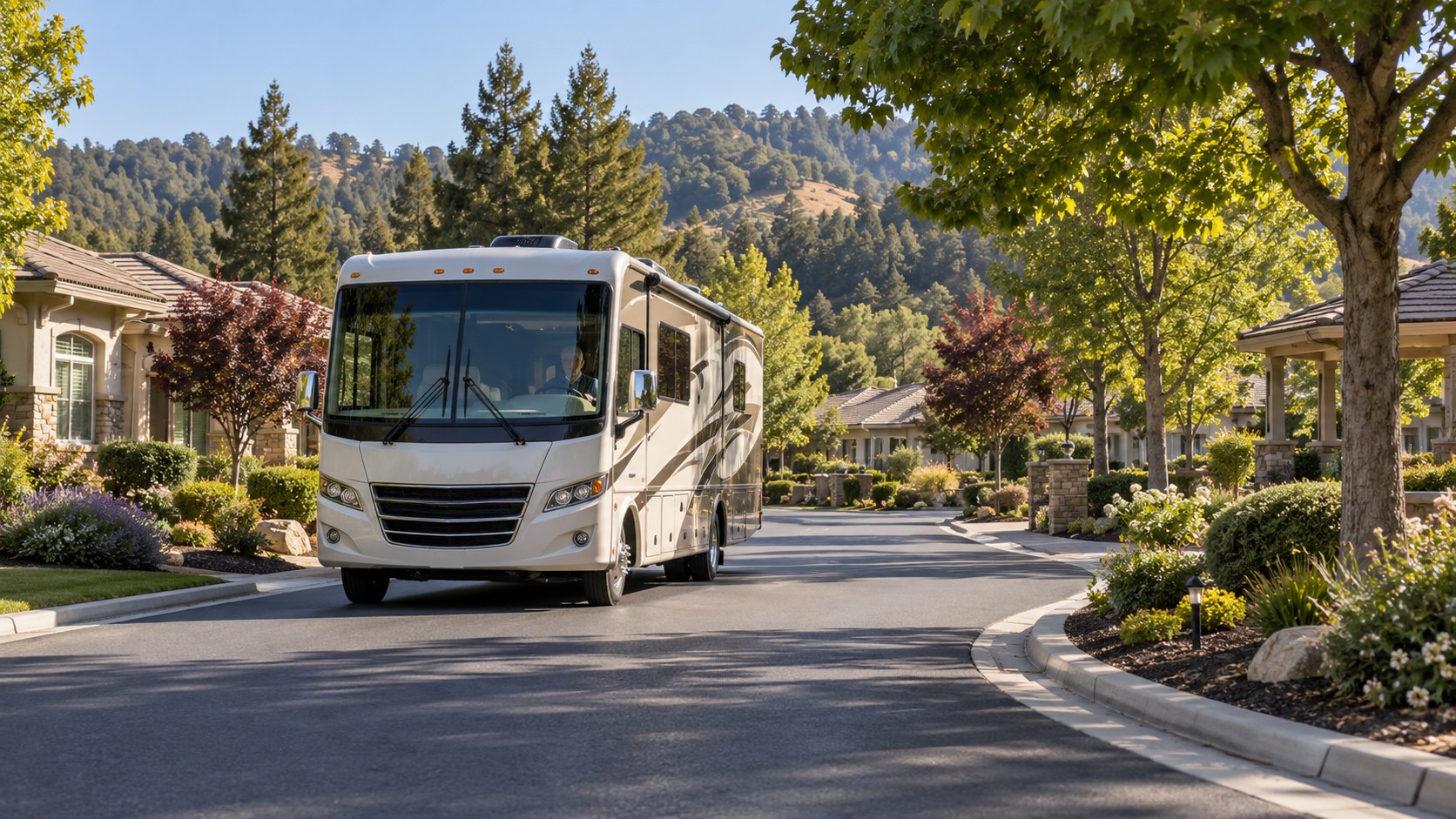
When buyers ask where an RV or boat can live in a 55+ community, the answer they rarely expect is the one that solves the problem outright: many communities have designated, resident-only RV parking zones set aside on association property, and the fee is small, in many cases around $25 per month per spot. That modest monthly fee buys a permanent, legal place for a motorhome, boat, or trailer, minutes from the front door.
The key phrase is resident-only. These zones exist for the people who live in the community, and the owner must prove ownership of the RV, boat, or trailer they want to park there. Communities do not allow outside people to park in these zones: no friends' rigs, no storage-for-hire from the association lot, and no passing a spot along to someone who does not live there. Practically, that means bringing proof of ownership when you register the vehicle, exactly the kind of paperwork the community manager can walk you through.
The honest caveat: many communities have these zones, not all of them. Some zones are paved lots behind a gate, some are rows of gravel stalls, and the fee, the wait, and the registration rules are set by each association. So the $25 figure is the common shape of the answer, not a statewide price list: ask the community what its current zone fee is, whether the zone is full, and exactly what proof of ownership it wants, in writing.
Why the zone matters more than the monthly fee
A resident-only zone is not just about saving money versus off-site storage, though it usually does: at around $25 per month, a zone spot costs a fraction of most storage yards. It is about keeping the vehicle where you can see it, hook up to it, and take a weekend trip without a long drive first. For people who use their rig a few times a year, the convenience is the whole point. Ask the community manager whether the zone is resident-only, what the verification process looks like, and whether the fee is collected in the monthly assessment or billed separately.
Off-site storage: the common alternative
For communities that do not allow on-site RV or boat parking, and for buyers who simply want the vehicle out of sight between trips, off-site storage is the standard solution. Across Northern California, outside parking and storage for RVs and boats has averaged roughly $75 to around $200 per month depending on location, and some good lower-end deals around $75 per month are available. Notice the shape of that sentence: these are ranges, not promises. A fenced, gated, covered or uncovered stall, in Lincoln versus Rocklin versus Sacramento, at a yard that is full versus one opening up, can sit at very different points on that range.
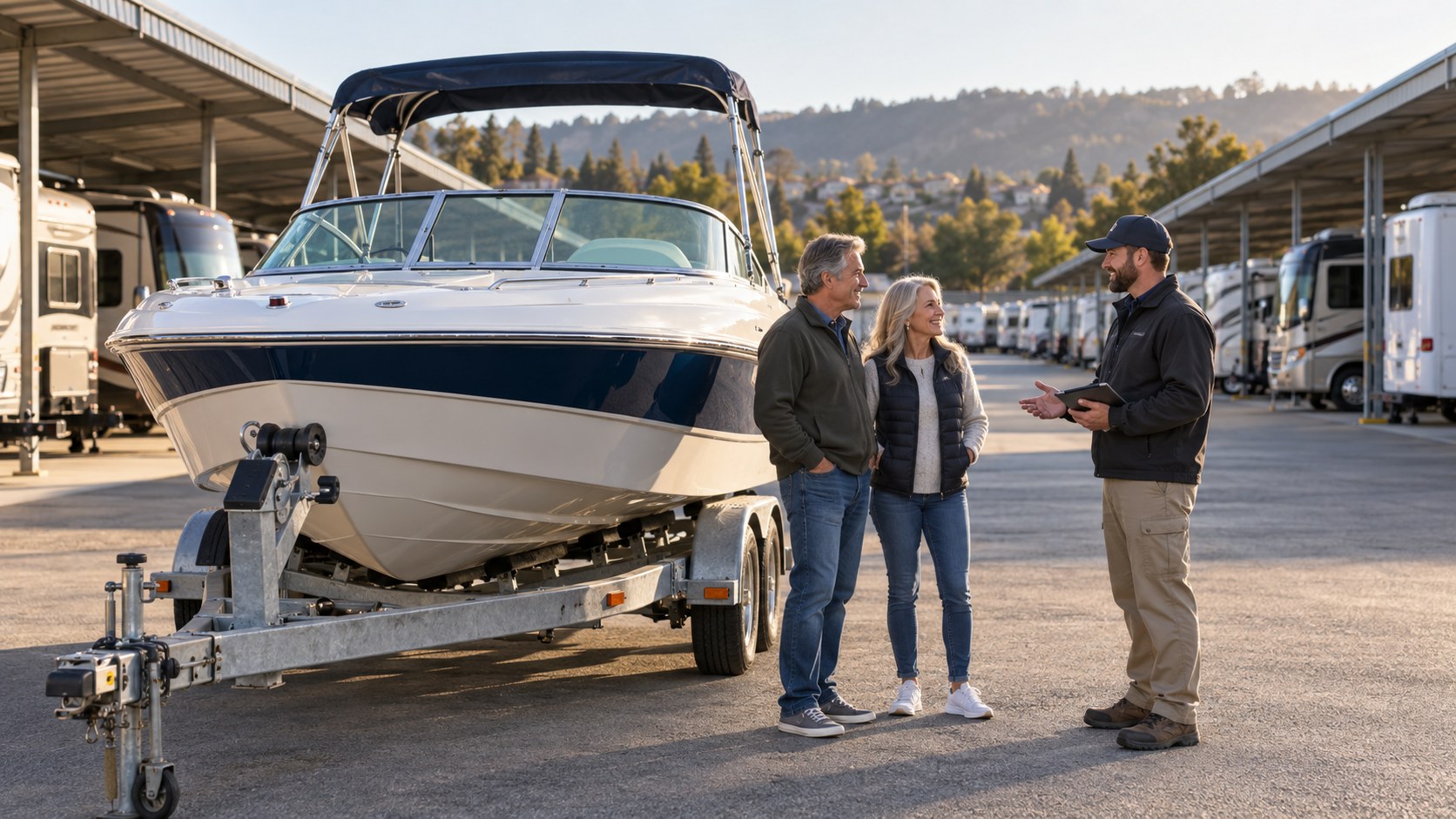
Two practical notes on off-site storage. First, confirm the price at the facility itself on the day you plan to use it: storage pricing moves, seasonal discounts appear, and a quote two years old is not a quote at all. Second, check with the community about whether off-site storage satisfies its rules. Most associations are happy with it, and some ask for proof of a storage agreement. A one-line answer from the community manager, kept in writing, makes the whole arrangement official.
Distance matters more than people expect. Ten minutes to the storage yard is fine on a sunny Saturday; forty-five minutes changes whether the boat ever gets used. When we tour communities with clients, we look up where the nearest RV and boat storage is before the tour ends, and it regularly becomes part of the value conversation between otherwise comparable communities.
The reality of the rules: out of sight, sized, and community by community
Between the two good news options, zone or storage, sits the sober part of the answer: the fine print. Every community's rules come from its CC&Rs and written policies, and they answer four questions differently in every community: whether RVs and boats must be stored out of sight, whether street or driveway parking is allowed at all, what weight and size limits apply, and how strictly the rules are enforced.

The out-of-sight question is the one that surprises most buyers. Some communities take the position that a driveway full of motorhome is exactly what the CC&Rs exist to prevent, so recreational vehicles must be parked behind a fence, inside a garage, or off site. Others permit a driveway spot within size limits, and a few allow limited street parking. There is no pattern worth betting on from one brand of community to another: the same developer's two communities can state the rule differently, which is exactly why our comparison of Sun City Roseville and Sun City Lincoln Hills treats parking as one of the differences to check, not a given.
Weight and size limits are the second surprise. An association may welcome RVs in its designated zone while capping length, height, or weight in its written rules, which can matter enormously for larger fifth wheels and motorhomes. And enforcement varies: some associations patrol actively, some act on neighbor complaints, and the practical difference between two communities with identical written rules can be large. None of this is a reason to avoid 55+ communities; it is the reason to read the documents before you buy.
This is the same discipline the age rules require, and it is worth stating plainly: the federal Housing for Older Persons Act (HOPA) sets the 55+ occupancy framework, but HOPA does not write parking rules and neither does the state. Parking is a CC&R matter. Our explainer on age requirements and the HOPA rules covers the occupancy layer, and the complete guide to buying in a 55+ community carries the full checklist that includes reading the CC&Rs, asking the manager, and verifying the rules in writing before the offer.
The parking questions to ask before you buy
Bring this list to the community office, or better, send it in writing and keep the answers. Each question is answerable by the community manager from the CC&Rs, and each answer is the kind of thing that belongs in your offer file.
- Does this community have an RV or boat parking zone, and is it resident-only?
- What does the zone cost per month, what is the verification process to prove ownership, and are there limits on how many vehicles per household?
- Must RVs, boats, or trailers be stored out of sight, inside a garage, or off site?
- Is street parking or driveway parking of an RV or boat allowed at all, and are there weight, length, or height limits?
- If off-site storage is used, does the community require proof of a storage agreement?
- How does the association enforce the parking rules, and who do I ask if I have a question after closing?
Why in writing? Verbal answers are easy to remember differently later. A written answer, even by email, gives you the association's own words on file, and if the rule changes before your closing date, you have a record of what was represented when you decided to buy.
Questions buyers ask us about RV and boat parking
The short versions of the questions we answer in appointments and on tours, with the same caveat each time: the specific community's documents rule, and we will help you read them.
Does every 55+ community have an RV parking zone?
No. Many communities do, which is why this is a hopeful answer, but not all of them, and not always in the same way. Some zones are paved lots on association property, some are fenced resident areas, and some communities have no zone at all. Claiming every community has one would be wrong; the honest position is that many do, the setup varies, and the specific community’s documents settle it.
If a community has a resident-only zone, how do they verify ownership?
The owner typically has to show they own the RV, boat, or trailer they want to park, often by registering it with the association and providing proof of ownership. The point of a resident-only zone is that outsiders cannot use it: no renting your spot to a neighbor’s relative, no storage for people who do not live there. Ask for the exact registration and verification process in writing.
Does off-site storage count as “satisfying” the community’s parking rules?
Usually yes, and it is the common alternative in communities that do not allow on-site RV or boat parking. The community may still want to know where the vehicle is kept, and some associations ask for proof of a rental agreement. Confirm the requirement with the community manager and keep the receipt.
Do the HOPA age rules affect RV parking?
Not directly. The Housing for Older Persons Act governs the age composition of who lives in a 55+ community, not where residents park their recreational vehicles. RV and boat parking is controlled by each community’s CC&Rs, the same documents that carry the age rule. Our guide to age requirements and the HOPA rules explains that layer separately.
Where do I find the exact RV and boat parking rules for a community?
In the community’s recorded CC&Rs and any written rules (sometimes called community rules, regulations, or policies), plus a written answer from the community manager. Ask before you make an offer: one written question on parking can save a very expensive surprise after closing. We help buyers pull and read the documents every week.
Get the Parking Rule in Writing Before the Offer
Whether you are deciding between a community with a resident-only RV zone and one that relies on off-site storage, or you just want the CC&Rs read by someone who does it every week, Gary and Rutsell will pull the current documents with you and help you ask the right questions in writing.
Call or text Gary at 916-595-4279 · Rutsell at 916-695-2800, or send a message through our contact page.
The Gary Lee Team · eXp Realty of Northern California, Inc. · CA DRE #01448722 / #02067791
Sources and Official References
Parking rules for 55+ communities are set by each community's own CC&Rs and written policies, not by a single state law, so the primary source for any specific community is its own documents. Everything below was reviewed September 24, 2026; rules change, and the version that binds your closing date is the current one from the community, confirmed in writing.
- The Complete Guide to Buying in a 55+ Community in Northern California (NorCal55Plus) The pillar guide with the CC&Rs and checklist steps this post aligns with, including verifying rules with the community manager in writing before buying. Checked September 24, 2026.
- Age Requirements and the HOPA Rules, Explained (NorCal55Plus) The companion guide to the federal 55+ age layer, which does not write parking rules; parking is a CC&R matter. Checked September 24, 2026.
- Sun City Roseville vs. Sun City Lincoln Hills (NorCal55Plus) The flagship community comparison, an example of how two communities write the same category of rule differently. Checked September 24, 2026.
- 42 U.S.C. section 3607: Housing for older persons exemption (Cornell Legal Information Institute) The federal statute behind the 55+ age exemption; included to show where the age layer lives and that it does not govern parking. Checked September 24, 2026.
Last reviewed: September 24, 2026. This article is general consumer education, not legal advice for your specific situation, and the fee figures in it are ranges Gary provided, not promises: confirm current pricing at the facility and with the community. Where a community rule is not verified here, confirm it with the association in writing. Gary Lee, CA DRE #01448722 · Rutsell Fabillar Lee, CA DRE #02067791 · Brokered by eXp Realty of Northern California, Inc. Equal Housing Opportunity.